

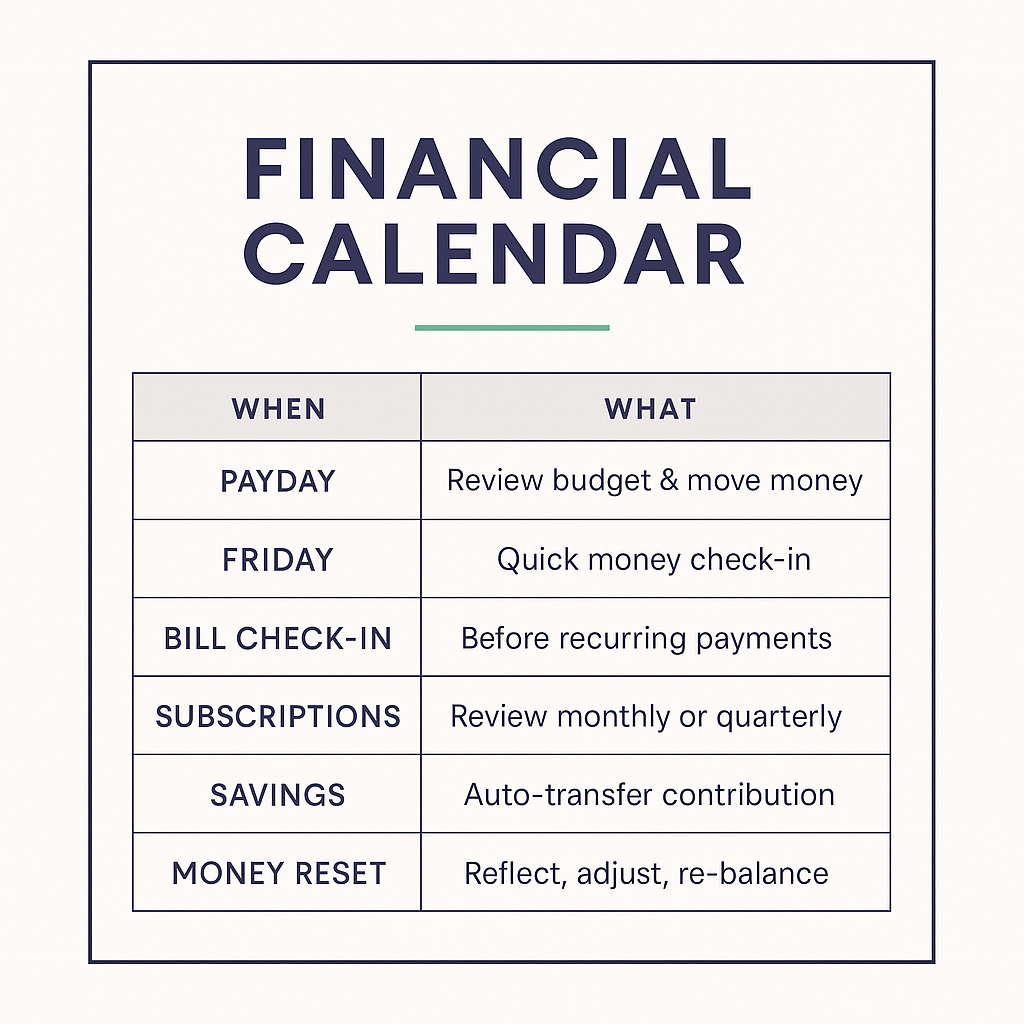
If your money habits feel reactive, stressful, or scattered, a financial calendar might be the simplest way to get ahead of the chaos. Think of it like a planner for your money — one that puts important dates, regular check-ins, and small rituals into a rhythm that supports you.
You don’t need to be a spreadsheet expert or budgeting nerd. You just need a system that gives you clarity without adding pressure.
Let’s break down how to set up a calm, low-maintenance financial calendar you’ll actually want to stick with.
What Is a Financial Calendar? (And What It Isn’t)
A financial calendar isn’t a budget — it’s a time-based structure that reminds you to engage with your money regularly, instead of only when there’s a problem.
At its simplest, it’s a set of recurring reminders (digital or paper) that help you:
- Know what’s coming (bills, paydays, renewals)
- Make small tweaks before things snowball
- Feel less panicked and more proactive
It’s the money equivalent of meal planning or a skincare routine — a soft structure that makes your life smoother.
📎 MoneyHelper: Budgeting and financial routines
Step 1: Choose Your Tools
Here’s what you’ll need to set up your financial calendar:
| Tool | Purpose |
|---|---|
| Google Calendar | Free, recurring reminders with notifications |
| Emma | Weekly spending insights, nudges, and progress tracking |
| Monzo Pots / Wise jars | Visual separation of money into categories |
| Notebook or printable | For offline users or creative thinkers |
💡 Tip: Keep it simple. Start with one calendar and one money app — no need to overcomplicate it.
Step 2: Set Monthly Financial Events
Add these to your calendar as recurring events:
📅 Payday Review
- Review income (expected vs. actual)
- Move money into savings or bills pots
- Double-check upcoming expenses
📅 Bill Check-In (2–3 days before payments)
- Make sure enough is in the account
- Avoid missed payments or overdraft fees
📅 Subscription Audit (monthly or quarterly)
- Cancel unused or forgotten services
- Emma can surface these automatically
📅 Savings Transfer
- Even £10/week counts — set it and forget it
- Transfer to specific pots: travel, Christmas, repairs, etc.
📅 Month-End Reset
- Review Emma summaries or Monzo spending history
- Ask: what felt good this month? What was stressful?
You can colour-code these or set different reminder tones to distinguish between types.
Step 3: Add Weekly Micro-Rituals
Weekly check-ins stop small issues becoming big problems. Ideas:
- 10-min Sunday money reset: glance over spending, prep for the week
- Check sinking fund pots: do they need topping up?
- Update your joy or fun budget: give yourself permission to spend with clarity
💬 Ask yourself: “What do I need from money this week?” (Security? Joy? Stability?)
Step 4: Build Seasonal or Quarterly Reviews
Once every 3 months, zoom out:
- Are your goals on track?
- Has your income or spending changed?
- Do you need to adjust your categories or savings targets?
Use this time to reset intentions, update your goals, or refresh your calendar. Optional tools:
- Google Sheets or Notion trackers
- Emma insights over time
Step 5: Make It Actually Work for You
What makes a financial calendar stick?
- Start small: just 1–2 events weekly is enough
- Set gentle reminders — not alarms that cause panic
- Celebrate consistency, not perfection
- Use visual cues: stickers, colours, emojis
- Review and tweak — your system should evolve with you
Optional event idea: Emergency Money Check-In — a 15-minute buffer time when you feel spirally or overwhelmed.
Optional Add-Ons for Visual Thinkers
- Printables: Create or download a financial calendar template
- Wall planners: Use for visual reminders of big savings dates
- Emma & Monzo integrations: These help you track spending patterns that feed your calendar insights
Final Thoughts: Your Calendar = Your Calm
You don’t need perfect money habits to feel on top of things — just consistent check-ins and kind reminders. A financial calendar gives your money a rhythm that matches your life.
Start where you are. Add one payday check-in. One money review. One monthly savings transfer. Let it grow from there.
Your future self doesn’t need perfect — they just need you to look, adjust, and keep showing up.
📎 Try setting up your first 3 financial calendar events this week — and notice how even the smallest rituals can shift your sense of control.