

Most of us are taught to think about money the way we think about maths or science. There are rules. There are right and wrong answers. If you just follow the formulas — spend less than you earn, invest early, avoid debt — you’ll be fine.
And yet, so many of us aren’t fine. We know the rules. We just don’t follow them. Or we follow them, and still feel lost. Ashamed. Behind.
Why?
Because personal finance isn’t a science problem. It’s a human one. It doesn’t live neatly in spreadsheets or algorithms. It lives in our memories, our beliefs, our fears, and the conversations we overheard in childhood kitchens or on long drives home.
As Morgan Housel writes in The Psychology of Money:
“Through collective trial and error over the years, we learned to become better farmers, skilled plumbers, and advanced chemists. But has trial and error taught us to become better with our personal finances? Are we less likely to bury ourselves in debt? More likely to save for a rainy day? Prepare for retirement? Have realistic views about what money does, and doesn’t do, to our happiness? I’ve seen no compelling evidence.
Most of the reason why, I believe, is that we think about and are taught about money in ways that are too much like physics (with rules and laws) and not enough like psychology (with emotions and nuance).”
This idea cuts to the core of why so much traditional money advice feels sterile and ineffective. Financial education has long focused on the mechanical: compound interest, asset allocation, budgeting strategies. But it rarely asks how someone feels when they log into their bank account, or whether they associate money with freedom, or fear.
We grow up absorbing unspoken rules about money, often without realising it. For some, money is security. For others, it’s a source of conflict. For many, it’s simply something you’re not supposed to talk about. These emotional undercurrents don’t disappear when we become adults. They sit quietly beneath the surface, shaping how we earn, spend, save, and give.
When we treat money like physics, we assume it behaves predictably. Spend less, save more, and you’ll be fine. But when we treat money like psychology, we make space for the irrational, the messy, the deeply personal. We begin to understand why someone might have an emergency fund and still feel unsafe. Why a person with a high income might feel constant scarcity. Why a £3 coffee can trigger guilt for one person and comfort for another.
We also begin to see how deeply money is tied to identity. Not just who we are, but who we think we’re allowed to be. A child who grew up hearing that “rich people are greedy” may unconsciously self-sabotage when they start earning well. Someone who grew up with financial instability might hoard money or fear spending, even when they have enough. These behaviours don’t stem from ignorance. They stem from emotional conditioning.
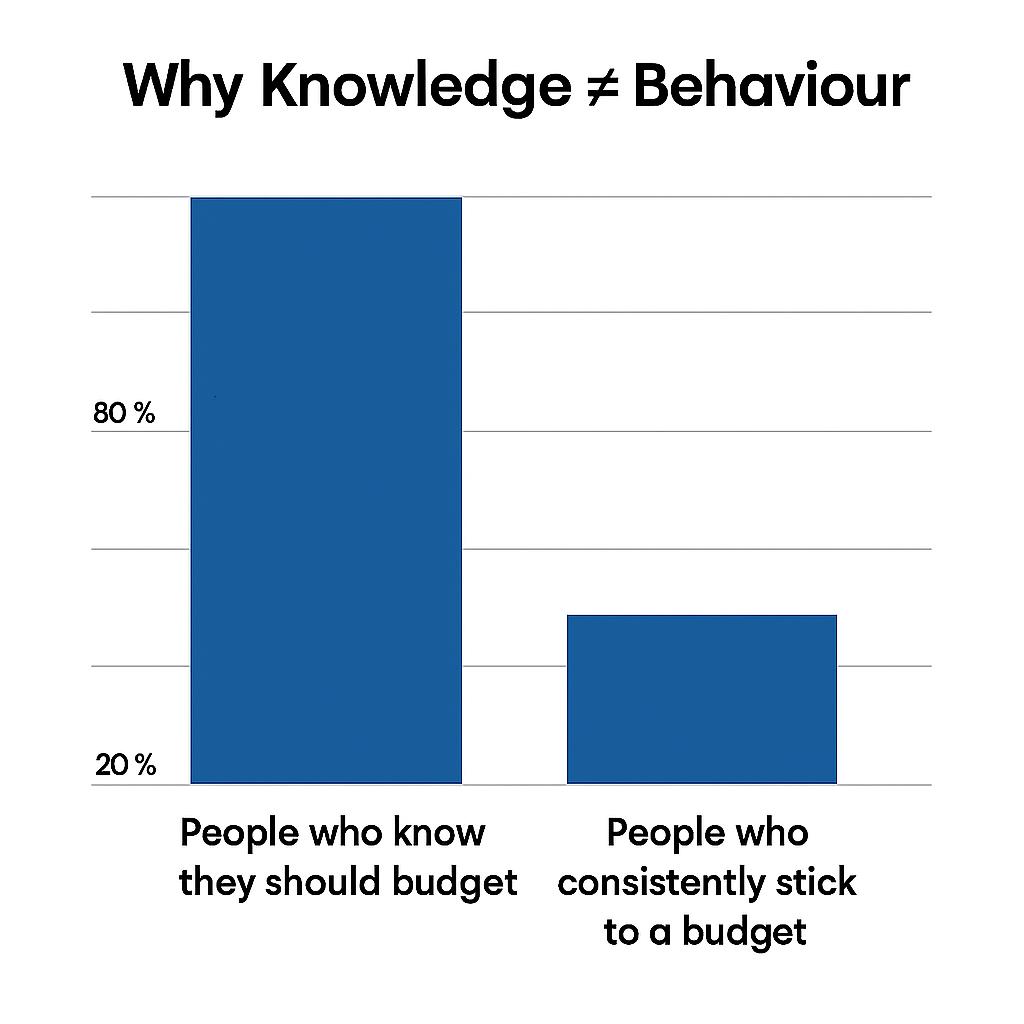
Financial advice that ignores this emotional layer often feels hollow. It doesn’t reach the parts of us that need to be seen and soothed. It doesn’t make space for grief, or class, or trauma. It says: here are the rules, just follow them. But humans don’t work like that.
To truly support people in building financial confidence, we have to meet them where they are. And where they are is often not in a place of logic. It’s in a place of anxiety. Or avoidance. Or over-control. Not because they’re irresponsible, but because their relationship with money has been shaped by real experiences — often painful, sometimes shameful, rarely talked about.
Imagine what financial education might look like if it started with questions instead of formulas. What if we asked: What’s your earliest memory of money? When did you learn what “enough” means? Whose voice do you hear when you spend?
Imagine a world where we were encouraged to explore our emotional responses to money without judgement. Where financial literacy didn’t just mean understanding credit scores and pensions, but also understanding why we freeze at the thought of investing, or why we feel guilty for wanting more.
The truth is, the numbers are only half the story. The rest lives in our bodies, our stories, our nervous systems. And when we start to pay attention to those deeper layers, something remarkable happens: we stop seeing money as something we’re supposed to master, and start seeing it as something we can learn to relate to, with more care and curiosity.
That doesn’t mean we ignore the practical. Budgets matter. Saving matters. Investing wisely can change lives. But none of it will stick if we’re still carrying unspoken fear or shame.
No one ever said: ‘Hey, of course this feels hard — you’re carrying decades of inherited beliefs, quiet fears, and rules you didn’t choose.’ But that would’ve helped more than any budget ever did.
You don’t have to turn yourself into a spreadsheet to be good with money. You don’t need to perform financial perfection to be worthy of stability. What you need is space to understand yourself. To unlearn what no longer serves you. And to know that you’re not the only one facing financial uncertainty.
Because money isn’t physics. It never was. It’s psychology. And that changes everything.
M
S