

“What if you didn’t wait until 65 to rest? What if you could take a break now – on purpose, not just when you’re burned out?”
This is the financial planning guide for people who want to press pause, without hitting panic mode.
What Is a Micro-Retirement? (And Why More People Are Doing It)
Let’s unlearn the idea that rest is something we earn after we’ve burned out.
A micro-retirement is a planned break from work, taken mid-career instead of waiting until traditional retirement age. Think of it as hitting pause – whether for 3 months, a year, or longer – to rest, reassess, or pursue something that’s been sitting on your heart.
It’s different from a traditional sabbatical (which usually requires employer permission) and it’s not necessarily about quitting forever. It’s about making space, on purpose.
Since the pandemic, there’s been a shift. People are questioning the “grind now, live later” model. Instead of pushing through chronic burnout, some are choosing to build in breathing room. That might look like a year of travel, a few months to recover from stress or illness, or time to care for family or launch a creative project.
If you’ve been daydreaming about taking time off but the finances feel impossible – this guide is for you.
Can You Afford to Take a Break? Start Here.
The real question isn’t “Can I afford it?” It’s “How can I make it possible – and safe?”
Before we talk numbers, start with this:
Taking a break doesn’t make you reckless or lazy. It makes you honest. And your finances can support your values when you give them a plan.
Step 1: Clarify Your ‘Why’ and Time Frame
Ask yourself:
- Why do I want this break?
- How long do I want it to last?
- What do I need (emotionally, mentally, financially) during that time?
Your “why” gives the plan purpose, and helps you design it around what matters most.
Step 2: Calculate Your True Cost of Living
This isn’t your usual monthly budget. It’s your break life budget.
Consider:
- Rent/mortgage
- Utilities and groceries
- Health insurance or medical costs
- Travel (if applicable)
- Subscriptions, debt repayments
- Small joys (yes, you’re allowed lattes on sabbatical)
Then multiply by the number of months you want off.
Add 10–15% to cover:
- Emergencies
- Inflation
- Return-to-work expenses (more on this below)
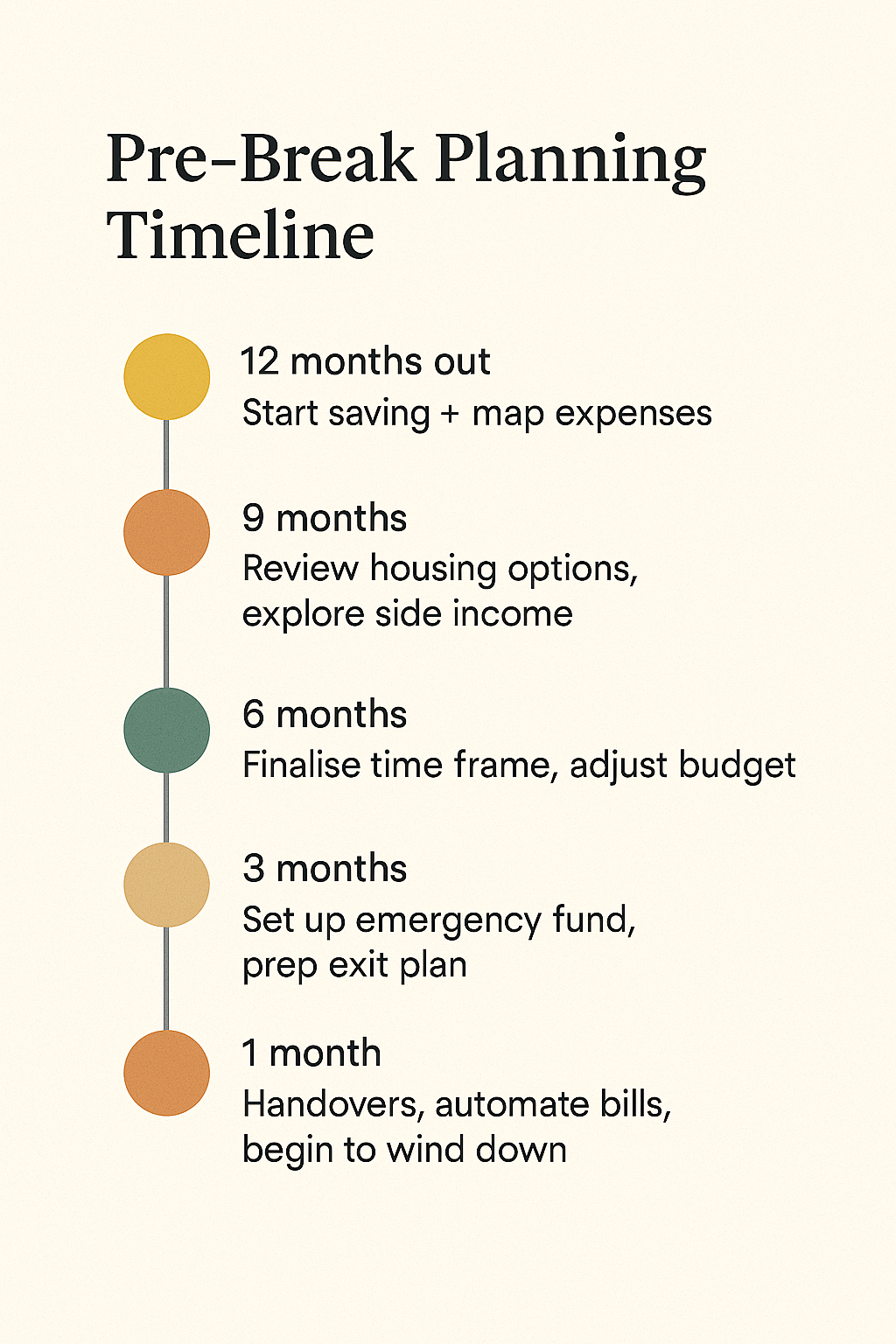
Step 3: Build in a Buffer (and Then Some)
An emergency fund is still essential – especially when you’re not earning regularly.
Try to save:
- 3–6 months of living costs +
- 2–3 months’ worth for job-hunting or transition time
If that number feels overwhelming, start small. Every month you build towards it is one month closer to freedom.

How to Financially Prepare (Without Burning Out First)
You don’t need to live like a monk to take time off. But you do need a strategy that’s kind and clear.
Start a Dedicated “Freedom Fund”
Open a savings pot just for your break. Label it something that keeps you connected to your goal:
- “Rest Fund”
- “Creative Year”
- “Sabbatical Stash”
Automate contributions, even if it’s £50 a month. You’re building your own safety net.
Pause or Reduce Big Financial Commitments
Look at your fixed costs and see what can be reduced or paused:
- Pension overpayments
- Subscriptions and memberships
- Debt repayments (check if payment holidays are an option)
If rent or mortgage is your biggest cost, explore flat-sharing, subletting, or even house-sitting options during your break.
Consider Side Income (Soft Landing, Not Hustle)
If you want a cushion without full-time pressure:
- Rent out a room or your flat on Airbnb
- Sell digital products (e.g. templates, courses, stock photos)
- Take on occasional freelance work
You’re not trying to build an empire – just soften the financial transition.
Reader Story: “How I Took a 6-Month Break at 32 (and Didn’t Go Broke)”
“I wasn’t burned out. I was burned up.”
— Liv, 32, London
Liv had been working in marketing for 9 years when she started feeling detached from everything – her job, her friends, even herself.
“Every Monday, I felt like I was suiting up for battle. I had savings, but I kept telling myself I’d take a break ‘next year’.”
After a minor health scare and some hard conversations, Liv decided to take a 6-month break from work. Here’s how she made it work:
- She created a “Freedom Fund” and saved £7,000 over 18 months.
- She moved back in with family for 3 months to cut costs.
- She travelled solo for 2 months on a budget using Workaway and house-sitting gigs.
- She did zero career development during her time off. Just rested.
“I thought it would ruin my career. Instead, it gave me the clarity to change industries completely.”
What Happens After the Break? Planning the Return
The break is only half the story. Give future-you a soft landing.
The Re-Entry Fund
Budget at least 2–3 months’ expenses for your return period. It might take a while to land a new job or ease back into work.
Update your CV and LinkedIn while you’re still off, even lightly. Keep a digital folder of things you’d like to explore post-break.
Upskill or Pivot (Optional, Not Required)
Some people use breaks to learn, study, or change careers—but this is not a requirement.
If it feels energising, go for it. If not, rest is reason enough.
What If I Can’t Afford to Quit Completely?
Not all breaks have to be full stop. It’s okay to rest in stages.
Here are flexible options:
- Take a 3-month unpaid leave (negotiate if employed)
- Reduce to part-time or 4-day weeks
- Stack annual leave + bank holidays for a longer stretch
- Use remote work to live abroad temporarily (geoarbitrage)
The goal is to create breathing room without destabilising your finances. You don’t need to go all or nothing.
The Emotional Side of Taking a Break
Let’s talk about the voice in your head that says this is irresponsible.
That voice is likely rooted in:
- Fear of being seen as lazy
- Internalised capitalism (“I am what I produce”)
- Anxiety around money scarcity
But choosing to pause is an act of financial self-trust.
You’re not giving up – you’re creating space for something different. And there’s no shame in needing a break. In fact, it’s often the bravest, hardest thing to admit.
If you need extra support around mindset, we recommend:
- The Psychology of Money — Morgan Housel
- Rest Is Resistance — Tricia Hersey
A Note for Freelancers and Self-Employed Folks
You’re not broken because you don’t have a corporate sabbatical policy.
Planning a break when you’re self-employed takes longer – but it’s doable.
Try this:
- Map out your average monthly income for the past 12 months
- Identify your quietest seasons (use those for your break)
- Set up recurring income if possible (retainers, digital products)
- Reduce clients or workload gradually before the break
A 12-month savings runway might be needed. But you get to design it on your own terms.
A Kinder Financial Future: Why This Isn’t Selfish
You don’t need to earn rest. You need to plan for it – and protect it.
Taking time off isn’t quitting life. It’s choosing to live it more intentionally.
So many of us grew up believing rest was indulgent or irresponsible. But what if it’s part of the plan? What if it’s the smart thing to do?
You’re allowed to take breaks. You’re allowed to rest. And you’re allowed to build money habits that support that rest – without guilt.
🔗 External Resources
- How to take a sabbatical – Indeed
- National Careers Service UK – Return to Work Help
- Mental Health UK – Burnout and Work-Life Balance
M