
This isn’t just about tech. It’s about trust, safety, and your money story in the digital age.
First, What Is a Digital Financial Identity?
You might not realise how much of your financial “self” already lives online.
Your digital financial identity is the combination of personal, behavioural, and transactional data that represents you across the digital financial world. It’s how banks, apps, credit scoring systems, and even social media platforms “see” you.
That includes:
- Your name, date of birth, address, National Insurance number
- Your spending patterns, savings habits, debt levels, and credit score
- Login credentials, device IDs, biometrics, cookies
- The apps you use, the accounts you link, and the platforms you trust
Every time you open a banking app, pay with your phone, or sign up for a budgeting tool — you’re building this digital footprint.
Here’s the thing: Most of us never agreed to build this identity. It just happened, quietly, as our financial lives moved online.
Why It Matters (And Why Now)
This isn’t just a tech issue – it’s a money one. A trust one. A safety one.
The Rise of Fintech & Embedded Finance
In the UK, we’re seeing rapid growth in financial technology (fintech) – think neobanks like Monzo and Starling, BNPL services like Klarna and Clearpay, AI budgeting tools, investment apps, and robo-advisors.
Many of these tools are helpful. Some are brilliant.
But the more your finances are spread across apps, the more your data is shared, scraped, and sold. And because finance is now embedded into non-financial spaces (shopping apps, wellness apps, even social platforms), your digital financial identity is being shaped in places you wouldn’t expect.
Data Is the Product
If something is free – chances are, you are the product.
Many “free” financial tools make money by collecting and monetising user data. That might include:
- Selling anonymised spending trends to advertisers
- Sharing behavioural insights with credit scoring agencies
- Using your habits to upsell loans or credit cards
Even apps that feel trustworthy (like your favourite budgeting tool) might be collecting more than you think.
What Are the Risks to Your Financial Identity?
This isn’t about fear. It’s about awareness – and staying in control.
Identity Theft & Data Breaches
In 2023, UK fraud losses from authorised push payment (APP) scams reached £240.5 million.
Even large, regulated platforms aren’t immune to breaches. Monzo, Revolut, and Wise have all experienced data leaks or fraud attempts in recent years.
Your name, email, or bank details can be enough to open a line of credit, create a fake identity, or commit fraud in your name.
Behavioural Profiling
Some fintech tools use AI to analyse your habits – how often you check your balance, how you budget, how much you spend on takeaways.
This data may be used to flag you as “high risk” or push you toward short-term financial products, like credit or BNPL. The systems aren’t always transparent – and you may not know how your behaviour is being interpreted.
Loss of Privacy
It’s not just hackers. It’s slow, silent erosion of your financial autonomy.
If your financial identity is shaped by apps and systems that don’t align with your values – you may end up being nudged into choices that don’t serve you.
How to Protect Your Digital Financial Identity
(Without Going Off-Grid)
You don’t need to become a cybersecurity expert – or give up your phone.
But a few thoughtful habits can go a long way.
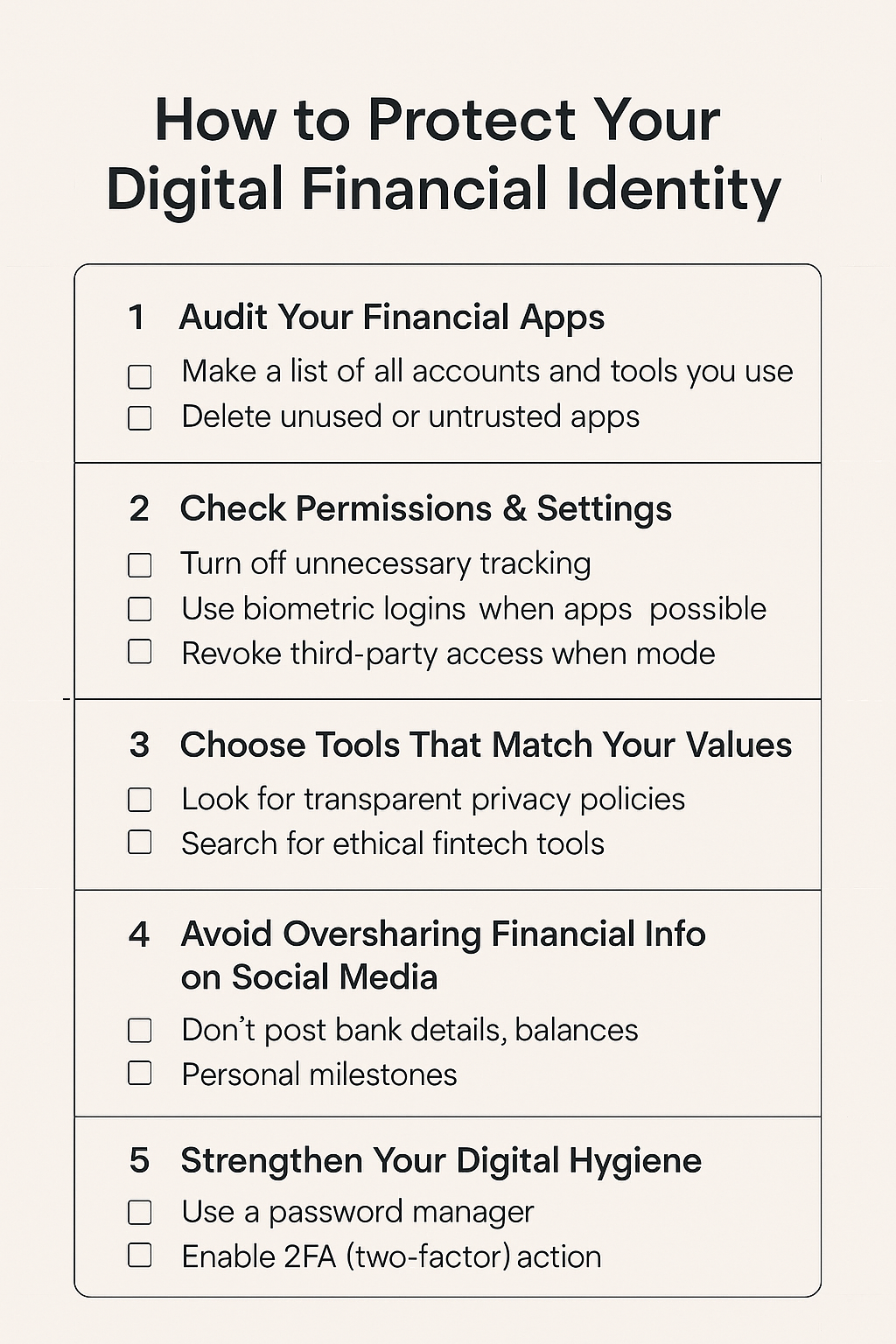
1. Audit Your Financial Apps
Make a quick list of every money-related tool you’ve signed up for – even ones you barely use.
- Banking apps
- Budgeting/spending trackers
- BNPL platforms
- Investment or crypto apps
- Cashback sites
Delete or deactivate anything you no longer use or trust. This isn’t about perfection – it’s about tightening the circle.
2. Check Permissions & Settings
- Turn off unnecessary tracking and sharing in app settings
- Revoke third-party access to your financial accounts
- Use biometric authentication (like fingerprint or Face ID) wherever possible
- Don’t reuse passwords — ever
We recommend setting up a password manager like Bitwarden or 1Password – both offer secure, encrypted storage for all your logins.
3. Choose Tools That Match Your Values
Ask yourself:
- Is this app transparent about how it uses my data?
- Does it sell user info to third parties?
- Does it help me feel more empowered – or more anxious?
Look for fintech companies that are B Corps, co-operatives, or ones with strong GDPR compliance and plain-English privacy policies.
4. Avoid Oversharing Financial Info on Social Media
It’s easy to get caught up in sharing screenshots of savings milestones or debt repayments.
But even blurred-out screenshots can contain:
- Account numbers
- Login times
- Device or location metadata
Scammers are becoming more sophisticated – and financially vulnerable people are increasingly targeted.
Keep your financial wins personal, or anonymise them properly.
What Is a Digital Wallet – And Is It Safe to Use?
A digital wallet is an app or service that stores your payment details and lets you pay contactlessly – online or in person.
Common examples:
- Apple Pay, Google Wallet
- Monzo, Revolut, Starling
- Wise, PayPal, Klarna
- Crypto wallets like Metamask or Ledger
Are They Safe?
Yes – generally. But safety depends on how you use them.
- Stick to known providers
- Avoid linking unnecessary accounts
- Use biometric logins and strong authentication
- Don’t click wallet links from random emails or texts
Pro tip: Don’t store everything in one place. If your main wallet app is hacked or your phone is stolen, your financial world shouldn’t unravel.
The Future of Your Digital Identity
This space is evolving fast – and we’re all learning as we go.
Here’s what’s coming next:
Open Banking
The UK’s Open Banking initiative gives consumers more control over their data – allowing secure sharing between financial providers. But it also means more systems are talking to each other. You still need to be careful who you connect with.
More info: https://www.openbanking.org.uk
AI-Based Profiling
Banks and fintechs are starting to use AI not just to track what you’ve done – but to predict what you’ll do next. This can be helpful (e.g. reminders, forecasts) – but it also raises questions about consent, transparency, and manipulation.
Consolidated Identity Wallets
The UK is testing GOV.UK One Login – a single digital ID for accessing government services.
Some fintechs are moving toward similar models. Whether this improves convenience or concentrates risk remains to be seen.
This Isn’t About Paranoia – It’s About Power
You don’t need to fear technology. But you do deserve to understand how your financial story is being shaped.
Your digital financial identity isn’t fixed, and it isn’t someone else’s domain – it’s something you can protect, refine, and reclaim.
M
S