
If you feel stuck when it comes to money—like you can’t check your bank account, face your bills, or even open a budgeting app—you’re not alone. And more importantly, you’re not broken.
Financial avoidance is a deeply human response to stress. It’s not about being lazy, irresponsible, or bad with money. It’s about your brain and body trying to protect you from emotional overload.
This guide explores what financial avoidance really is, why it happens, and how to gently move through it. We’re bringing emotional intelligence, behavioural psychology, and trauma awareness together to help you understand what’s going on beneath the surface—and how to support yourself.
What Financial Avoidance Really Is
Financial avoidance is when you avoid engaging with money—whether that’s checking your account, opening post, budgeting, or making financial decisions.
This isn’t a moral failing. It’s a nervous system response.
When money becomes a source of fear, shame, or threat, your brain might react with one of its built-in survival responses: fight, flight, freeze, or fawn. Financial avoidance lives in the freeze zone.
What It Might Look Like:
- Ignoring overdue bills or unopened letters
- Putting off opening your bank app—sometimes for weeks
- Feeling physically anxious when talking about money
- Numbness, procrastination, or zoning out during money tasks
📌 According to the Money and Mental Health Policy Institute, people with mental health conditions are three times more likely to be in problem debt. But that doesn’t mean avoidance only affects those with a diagnosis—it’s also a common response to chronic stress, instability, and financial trauma.
The Psychology (and Biology) Behind It
When money feels unsafe—whether due to past debt, job insecurity, or childhood experiences—your brain can treat it like a threat. That kicks off your body’s stress response, releasing cortisol and activating your amygdala, the part of the brain responsible for detecting danger.
In short: your body is reacting as if you’re being chased by a lion, not facing a spreadsheet.
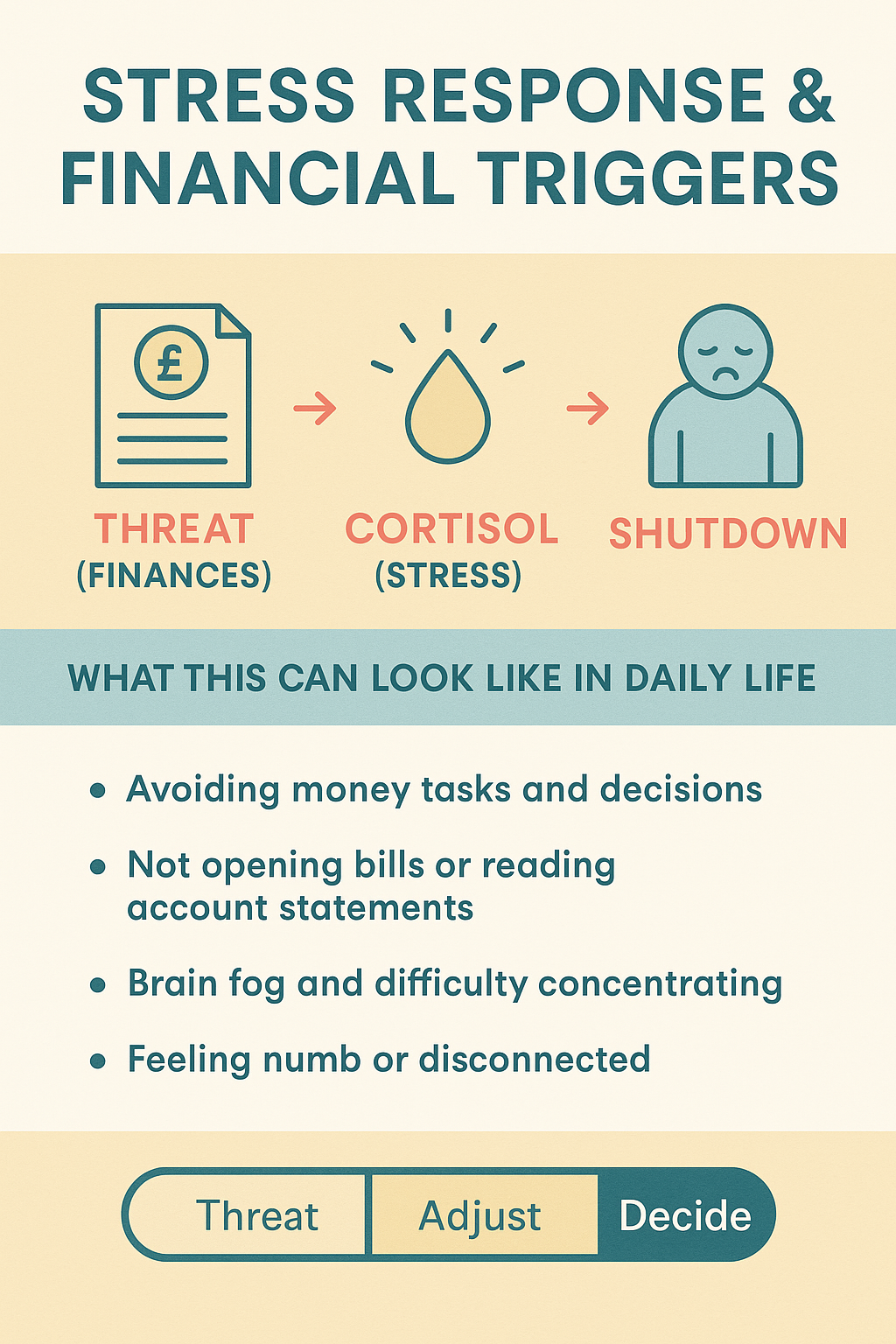
What Happens:
- Cognitive shutdown: Your prefrontal cortex (decision-making centre) goes offline
- Emotional flooding: Shame, guilt, or panic rise quickly
- Executive dysfunction: Even small tasks (like opening a bill) feel overwhelming
This is why people describe financial stress as foggy, paralysing, or physically exhausting. The feeling is real because the response is biological—not imagined.
📖 Related research: McEwen, B.S. (2007). Physiology and neurobiology of stress and adaptation: central role of the brain. Physiol Rev, 87(3), 873–904.
Signs You’re in Financial Freeze Mode
Think of this less like a checklist and more like a portrait. Financial freeze doesn’t always look the same—but here’s what it can feel like:
🌀 Avoidance – You know there are bills to pay or a budget to check, but the thought of looking fills you with dread. So you delay. One day becomes three weeks.
🧊 Emotional Numbness – Instead of panic, you feel… nothing. Money becomes a blank spot. You drift past it because feeling anything about it feels too hard.
🔄 Procrastination Loops – You set the intention to “finally deal with it” tomorrow. Then tomorrow comes—and it’s still too much. The cycle continues.
🧠 Mental Fog – When you try to focus on money tasks, your brain checks out. Concentration is hard. Even deciding where to start feels impossible.
🤐 Shame Spirals – The avoidance isn’t just about money—it becomes about you. Thoughts like “I’m so irresponsible” or “I’ll never get on top of this” create even more emotional weight.
How to Gently Begin Again (Without Overhauling Everything)
Avoidance thrives on overwhelm. The antidote isn’t a spreadsheet or a strict budget. It’s a single, small step.
1. Name What’s Happening
Label the emotion: “I feel anxious about money.” Research shows that naming emotions reduces amygdala activity and increases emotional regulation (Lieberman et al., 2007).
2. Start with a 5-Minute Money Reset
Don’t set out to “fix” your finances. Pick one micro-action:
- Open your banking app (no action required)
- Read one unopened letter
- Write down one recurring monthly cost
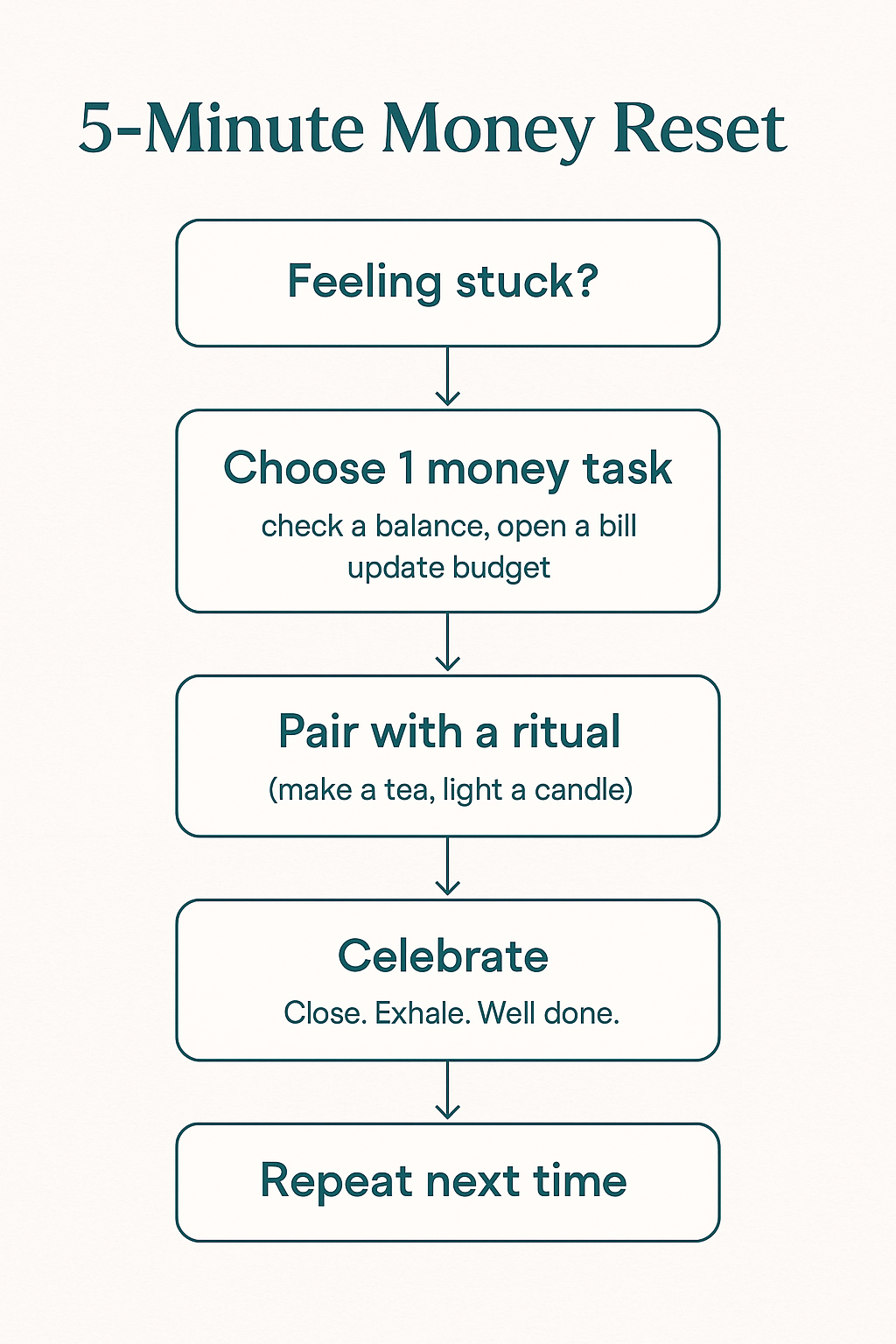
Even one action tells your nervous system: “This isn’t a threat.”
3. Pair Money Tasks With Soothing Rituals
- Light a candle
- Put on calming music
- Make a hot drink
Associating money tasks with safety cues (a principle of polyvagal theory) helps rebuild a calmer connection with your finances.
Build Emotional Safety Into Your Budgeting
Once the fog begins to lift, focus on creating a financial routine that feels safe. That means low-pressure, high-consistency habits:
- Set a weekly “money date” with yourself (even 10 minutes)
- Use Monzo Pots or Starling Spaces to visualise your money
- Automate what you can: savings, bill payments, standing orders
- Focus on just showing up—not perfect execution
These practices turn avoidance into engagement, without triggering overwhelm.
🛠️ Tools to try:
When to Reach Out for Support
If financial avoidance is significantly affecting your mental health, you don’t have to go it alone. Help is available, and it works.
UK Resources:
- Mental Health & Money Advice — https://www.mentalhealthandmoneyadvice.org/
- Money and Mental Health Policy Institute — https://www.moneyandmentalhealth.org/
- StepChange (debt support) — https://www.stepchange.org/
- Mind (mental health support) — https://www.mind.org.uk/
Consider:
- Talking to a financial coach who understands nervous system regulation
- Asking your GP for a referral to therapy (including CBT for anxiety)
- Confiding in someone you trust to reduce isolation
Financial avoidance is a trauma-informed issue, and it deserves compassionate support.
Final Thoughts: You’re Not Behind—You’re Protecting Yourself
If you can’t budget, can’t look, or can’t plan—it’s not because you’re lazy or incapable. It’s because something inside you doesn’t feel safe. That’s a nervous system story, not a moral one.
And it can change.
With small steps, soothing routines, and gentle awareness, you can rebuild a relationship with money that feels safe, steady, and empowering.
Start by showing up. That alone is a powerful act of healing.